A few weeks ago I wrote
How decentralized is Bluesky really?,
a blogpost which received far more attention than I expected on the
fediverse and Bluesky both. Thankfully, the blogpost was received
well generally, including by Bluesky's team. Bryan Newbold, core
Bluesky engineer, wrote a thoughtful response article:
Reply on Bluesky and Decentralization,
which I consider worth reading.
I have meant to reply for a bit, but life has been busy. We launched
a fundraising campaign over at Spritely
and while I consider it important to shake out the topics in this blog
series, that work has taken priority. So it is about a week and a
half later than I would like, but here are my final thoughts (for my
blog at least) on Bluesky and decentralization.
For the most part, if you've read my previous piece, you'll remember
that my assertion was that Bluesky was neither decentralized nor
federated. In my opinion many of the points raised in Bryan's article
solidify those arguments and concerns. But I still think "credible
exit" remains a "valuable value" for Bluesky. Furthermore, Bryan
specifically solicited a request to highlight the values of
ActivityPub and Spritely, so I will do so here. Finally, we'll
conclude by what I think is the most important thing: what's a
positive path forward from here?
Some high-level meta about this exchange
Before we get back into protocol-analysis territory, and for that
matter, protocol-analysis-analysis, I suppose I'd like to do some
protocol-analysis-analysis-analysis, which is to say, talk about the
posting of and response to my original blogpost. Skip ahead if you
don't care about this kind of thing, but I think there are interesting
things to say about the discourse and meta-discourse of technology
analysis both generally and how it has played out here.
Much talk of technology tends to treat said tech to be as socially
neutral as a hammer. When I buy a hammer from a hardware store, it
feels pretty neutral and bland to me. But of course the invention of
the hammer had massive social ramifications, the refinement of its
design was performed by many humans, and the manufacture of said
hammer happens within social contexts of which I am largely
disconnected. To someone, the manufacture and design of hammers is I
am sure deeply personal, even though it is not to me.
To me, decentralized networking tech standards and protocols and
software are deeply personal territory. I have poured many years of
my life into them, I have had challenging meetings where I fought for
things I believed important. I have made many concessions in
standards which I really did not want, but where something else was
more important, and we had to come to agreement, so a compromise was
made. I write code and I work on projects that I believe in. To me,
tech is deeply personal, especially decentralized networking tech.
So it took me a long time and effort and thinking to write the
previous piece, not only because I wanted to put down my technical
analysis carefully, but because I have empathy for how hearing a
critique of tech you have poured your life into feels.
I probably would not have written anything if it were actually not for
the invitation and encouragement of Bryan Newbold, whose piece is the
"Re:" in this "Re: Re:" article. People had been asking me what I
thought about ATProto and I said on a public fediverse thread that I
had been "holding my tongue". Bryan reached out and said he would be
"honored" if I wrote up my thoughts. So I did.
So I tried to be empathetic, but I still didn't want to hold back on
technical critique. If I was going to give a technical critique, I
would give the whole thing. The previous post was... a lot. Roughly
24 pages of technical critique. That's a lot to be thrown at you,
invitation or otherwise. So when I went to finally post the article,
I sighed and said to Morgan, "time for people to be mad at me on the
internet."
I then posted the article, and absurdly, summarized all 24 pages of
tech in social media threads both
on the fediverse
and on bluesky.
I say "summarized" but I think I restated nearly every point and also
a few more. It took me approximately eight hours, a full work day,
to summarize the thing.
And people... by and large weren't mad! (For the most part. Well,
some Nostr fans were mad, but I was pretty hard on Nostr's
uncomfortable vibes, which I still stand by my feelings on that.
Everyone else who was initially upset said they were happy with things
once they actually read it.) This includes Bluesky's engineering
team, which responded fairly positively and thoughtfully overall, and
a few even said it was the first critique of ATProto they thought was
worthwhile.
After finishing posting the thread, I reached out to a friend who is a
huge Bluesky fan and was happy to hear she was happy with it too and
that it had gotten her motivated to work on decentralized network
protocol stuff herself again. I asked if the piece seemed mean to
her, because she was one of the people I kept in mind as "someone I
wouldn't want to be upset with me when reading the article", and she
said something like "I think the only way in which you could be
considered mean was that you were unrelentingly accurate in your
technical analysis." But she was overall happy, so I considered that
a success.
Why am I bringing this up at all? I guess to me it feels like the
general assessment is that "civility is dead" when it comes to any
sort of argument these days. You can't win by being polite, and the
trolls will always try to use it against you, don't bother. And
the majority of tech critiques that one sees online are scathingly,
drippingly, caustically venomous, because that's what gets one the
most attention. So I guess it's worth seeing that here's an example
where that's definitively not the case. I'm glad Bryan's reply was
thoughtful and nice as well.
Finally, speaking of things that one is told that simply don't work
anymore, my previous article was so long I was sure nobody would
read it. And, truth be told, people maybe mostly read the social
media threads that summarized it in bitesized chunks, but there were
so many of those bitesized chunks. As a little game, I hid "easter
eggs" throughout the social media threads and encouraged people to
announce when they found them. For whatever reason, the majority of
people who reported finding them were on the fediverse. So from a
collective standpoint, congratulations to the fediverse for your
thorough reading, for collective collection of the egg triforce, and
for defeating Gender Ganon.
Okay, that's enough meta and meta-meta and so on. Let's hop over to
the tech analysis.
Interesting notes and helpful acknowledgments
Doing everything out of order of what one would be considered
"recommendable writing style", I am putting some of the least
important tidbits up front, but I think these are interesting and in
some ways open the framing for the most important parts that come
next. I wanted to highlight some direct quotes from Bryan's article
and just comment on them here, just some miscellaneous things that I
thought were interesting. If you want to see more pointed, specific
responses, jump ahead again to the next section.
Anything you see quoted in this section comes straight from
Bryan's article,
so take that as implicit.
A technical debate, but a polite one
First off:
I am so happy and grateful that Christine took the time to write
up her thoughts and put them out in public. Her writing sheds light
on substantive differences between protocols and projects, and
raises the bar on analysis in this space.
I've already said above that I am glad the exchange has been a
positive one and I'm grateful to see that my writing was well
received. So just highlighting this as an opening to that.
However, I disagree with some of the analysis, and have a couple
specific points to correct.
I highlight this only to remind that despite the polite exchange, and
several acknowledgments about things Bryan does say I am right about,
there are some real points of disagreement which are highlighted in
Bryan's article, and that's mostly what I'll be responding to.
"Shared heap" and "message passing" seem to stick
Christine makes the distinction between "message passing" systems
(email, XMPP, and ActivityPub) and "shared heap" systems
(atproto). Yes! They are very different in architecture, which will
likely have big impacts on outcomes and network
structure. Differences like this make "VHS versus BetaMax" analogies
inaccurate.
I'm glad that the terms "message passing" and "shared heap" seem to
have caught on when it comes to analyzing the technical differences in
approach between these systems. "Message passing" is hardly a new
term, but I think (I could be wrong) that "shared heap" is a term I
introduced here, though I didn't really state that I was doing so. I'm
glad to have seen these terms highlighted as being useful for
understanding what's going on, and I've even seen the Bluesky team use
the term "shared heap" to describe their system including around some
of the positive qualities that come from their design, and I consider
that to be a good thing.
If I were going to pull on a deeper amount of computer science
history, another way to have said things would have been "actor model"
vs "global shared tuplespaces". However, this wouldn't have been as
helpful; the important thing to deliver for me was a metaphor that
even non-CS nerds could catch onto, and sending letters was the
easiest way to do that. "Message passing" and "shared heap" thus
attached to that metaphor, and it seems like overall there has been
increased clarity for many starting with said metaphor.
Acknowledgment of scale goals
One thing I thought was good is that Bryan acknowledged Bluesky's
goals in terms of scaling and "no compromises". Let me highlight a
few places:
Other data transfer mechanisms, such as batched backfill, or routed
delivery of events (closer to "message passing") are possible and
likely to emerge. But the "huge public heap" concept is pretty
baked-in.
In particular, "big-world public spaces" with "zero compromises" is a
good highlight to me:
Given our focus on big-world public spaces, which have strong
network effects, our approach is to provide a "zero compromises"
user experience. We want Bluesky (the app) to have all the
performance, affordances, and consistency of using a centralized
platform.
And finally:
So, yes, the atproto network today involves some large
infrastructure components, including relays and AppViews, and these
might continue to grow over time. Our design goal is not to run the
entire network on small instances. It isn't peer-to-peer, and isn't
designed to run entirely on phones or Raspberry Pis. It is designed
to ensure "credible exit", adversarial interop, and other
properties, for each component of the overall system. Operating some
of these components might require collective (not individual)
resources.
By the way, I had anticipated in my previous blogpost that we would
see the space hosting requirements for Bluesky's public network to
double within the month. I underestimated!
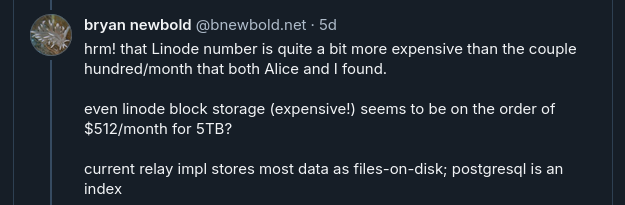
The cost of running a full-network, fully archiving relay has
increased over time. After recent growth, our out-of-box relay
implementation
(bigsky)
requires on the order of 16 TBytes of fast NVMe disk, and that will
grow proportional to content in the network. We have plans and paths
forward to reducing costs (including
Jetstream
and other tooling).
What's also highlighted above is that there are some new tools which
don't require the "whole network". I will comment on this at length
later.
Sizable endeavors
This section raised an eyebrow for me:
This doesn't mean only well-funded for-profit corporations can
participate! There are several examples in the fediverse of coop,
club, and non-profit services with non-trivial budgets and
infrastructure. Organizations and projects like the Internet
Archive, libera.chat, jabber.ccc.de, Signal, Let's Encrypt,
Wikipedia (including an abandoned web search project), the Debian
package archives, and others all demonstrate that non-profit orgs
have the capacity to run larger services. Many of these are running
centralized systems, but they could be participating in
decentralized networks as well.
The choice of community and nonprofit orgs here surprised me, because
for the most part I know the numbers on them. Libera.chat and and
jabber.ccc.de might be small enough, because IRC and XMPP are in
decline of use for one thing, but also because they're primarily
sending around low-volume plaintext messages which are ephemeral.
The other cases are particularly curious. The annual budgets of some
of these organizations:
These may sound like overwhelming numbers, but it is true that each
of these organizations is extremely efficient relative to the value
they're providing, especially compared to equivalent for-profit
institutions. My friend Nathan Freitas of the
Guardian Project likes to point out
that US military fighter jets cost hundreds of millions of
dollars... "when people complain about public funding of open source
infrastructure, I like to point out that funding signal is just asking
for a wing of a fighter jet!" Great point.
But for me personally, this is a strange set of choices in terms of
"non-profits/communities can host large infrastructure!" Well yes,
but not because they don't cost a lot. People often don't realize the
size and scale of running these kinds of organizations or their
infrastructure, so I'm highlighting that to show that it's not
something your local neighborhood block can just throw together out of
pocket change.
(But seriously though, could open source orgs have some of that
fighter jet wing money?)
Decentralization and federation terminology
If you are going to read any section of this writeup, if you are going
to quote any section, this one is the important one. For I believe the
terms we choose are important: how we stake the shape of language
affects what kinds of policies and actions and designs spring forth.
Language is loose, but language matters. So let us look at the
terminology we have.
A comparison of definitions
Bryan acknowledges my definitions of decentralization and federation,
and also acknowledges that perhaps Bluesky does not meet either
definition. Bryan instead "chooses his own fighter" and proposes two
different definitions of decentralization and federation from Mark
Nottingham's RFC 9518: Centralization, Decentralization, and Internet Standards.
First let us compare definitions. Usefully, Bryan highlights Mark's
definition of centralization (which I had not defined myself):
[...] "centralization" is the state of affairs where a single entity
or a small group of them can observe, capture, control, or extract
rent from the operation or use of an Internet function exclusively.
So far so good. I agree with this definition.
Now let us get onto decentralization. First my definition of
decentralization:
Decentralization is the result of a system that diffuses power
throughout its structure, so that no node holds particular power at
the center.
Now here is Bryan's definition (more accurately Mark Nottingham's
definition (more accurately, Paul Baran's definition)) of
decentralization:
[Decentralization is when] "complete reliance upon a single point is
not always required" (citing Baran, 1964)
Perhaps Bluesky matches this version of decentralization, but if so,
it is because it is an incredibly weak definition of decentralization,
at least taken independently. This may well say, taken within the
context it is provided, "users of this network may occasionally not
rely on a gatekeeper, as a treat".
Put more succinctly, the delta between the definition I gave and the
definition chosen by Bryan is:
- The discussion of power dynamics, and diffusion thereof, is removed
- The phrase complete reliance is introduced, opening acceptability
within the definition that incomplete reliance is an acceptable
part of decentralization
- The phrase not always required is introduced, opening
acceptability that even complete reliance may be acceptable, as long
as it is not always the case
When I spoke of my concerns of moving the goalpost, the delta between
the goalpost chosen in my definition and the goalpost chosen in
Bryan's chosen definition are miles away.
We'll come back to this in a second, because the choice of the
definition by Baran is more interesting when explored in its original
context.
But for now, let's examine federation. Here is my definition:
[Federation] is a technical approach to communication architecture
which achieves decentralization by many independent nodes
cooperating and communicating to be a unified whole, with no node
holding more power than the responsibility or communication of its
parts.
Here is Bryan's definition (more accurately Mark Nottingham's
definition):
[...] federation, i.e., designing a function in a way that uses
independent instances that maintain connectivity and interoperability
to provide a single cohesive service.
At first these two seem very similar. What, again is the delta?
- The discussion of power dynamics, once again, is not present.
- "Cooperation" is not present.
- And very specifically, "decentralization" and "no node holding more
power than the responsibility or communication of its parts" is not
present.
Reread the definition above and the definition I gave and compare: under
these definitions, any corporate but proprietary and internal
microservices architecture or devops platform would qualify. (Not an
original observation; thanks to Vivi for pointing
this out.) Dropping power dynamics and decentralization from the
definition reduces this to "communicating components", which isn't enough.
Bryan then goes on to acknowledge that this definition is a comparative
low bar:
What about federation? I do think that atproto involves independent
services collectively communicating to provide a cohesive and unified
whole, which both definitions touch on, and meets Mark's low-bar
definition.
However, in the context of Nottingham's paper, it's admittedly stronger,
because federation is specifically upheld as a decentralization
technique, which is missing when quoted out of context (though
Nottingham notably challenges whether or not it achieves that goal in
practice). Which turns out to be important. The "power dynamics" part
and specifically "immersing this definition in decentralization" parts
are actually really both very important parts of the definition I gave.
Bryan then goes on to acknowledge that maybe federation isn't the best
term for Bluesky, and leaves some interesting history I feel is
worthwhile including here:
Overall, I think federation isn't the best term for Bluesky to
emphasize going forward, though I also don't think it was misleading
or factually incorrect to use it to date. An early version of what
became atproto actually was peer-to-peer, with data and signing keys
on end devices (mobile phones). When that architecture was abandoned
and PDS instances were introduced, "federation" was the clearest term
to describe the new architecture. But the connotation of "federated"
with "message passing" seems to be pretty strong.
So on that note, I think it's fine to say, Bluesky is not federated, and
there's enough general acknowledgement of such. Thus it's probably best
if we move onto an examination of decentralization, and in particular,
where that definition came from.
"Decentralization" from RFC 9518, in context
Earlier I said "now here is Bryan's definition (more accurately Mark
Nottingham's definition (more accurately, Paul Baran's definition)) of
decentralization" and those nested parentheses were very intentional.
In order to understand the context in which this definition arises, we
need to understand each source.
First, let us examine Mark Nottingham's IETF independent submission,
RFC 9518: Centralization, Decentralization, and Internet Standards.
Mark Nottingham has a long and respected history of participating in
standards, and most of his work history is doing so for fairly sizable
corporate participants. From the title, one might think it a
revolutionary call-to-arms towards decentralization, but that isn't what
the RFC does at all. Instead, Nottingham's piece is best summarized by
its own words:
This document argues that, while decentralized technical standards may
be necessary to avoid centralization of Internet functions, they are
not sufficient to achieve that goal because centralization is often
caused by non-technical factors outside the control of standards
bodies. As a result, standards bodies should not fixate on preventing
all forms of centralization; instead, they should take steps to ensure
that the specifications they produce enable decentralized operation.
The emphasis is mine, but I believe captures well what the rest of the
document says. Mark examines centralization, as well as those who are
concerned about it. In the section "Centralization Can Be Harmful",
Mark's description of certain kinds of standards authors and internet
activists might as well be an accurate summation of myself:
Many engineers who participate in Internet standards efforts have an
inclination to prevent and counteract centralization because they see
the Internet's history and architecture as incompatible with it.
Mark then helpfully goes on to describe many kinds of harms that do
occur with centralization, and which "decentralization advocates" such
as myself are concerned about: power imbalance, limits on innovation,
constraints on competition, reduced availability, monoculture,
self-reinforcement.
However, the very next section is titled
"Centralization Can Be Helpful"! And Mark goes into great lengths
also about ways in which centralized systems can sometimes provide
superior service or functionality.
While Mark weighs both, the document reads as a person who authors
standards document who would like the internet to be more decentralized
where it's possible, but also operates from the "pragmatic" perspective
that things are going to re-centralize most of the time anyway, and when
they do this ultimately tends to be useful. It is also important to
realize that this is occuring in a context where many people are
worrying about increasing centralization of the internet, and wondering
to what degree standards groups should play a role. From Mark's own
words:
Centralization and decentralization are increasingly being raised in
technical standards discussions. Any claim needs to be critically
evaluated. As discussed in Section 2, not all centralization is
automatically harmful. Per Section 3, decentralization techniques do
not automatically address all centralization harms and may bring their
own risks.
Note this framing: centralization is not necessarily harmful, and
decentralization may not address problems and may cause new ones.
Rather than a rallying cry for decentralization, Mark's position is in
many ways a call for a preservation of the increasing status quo: large
corporations tend to be capturing and centralizing more of the internet,
and we should be worried about that, but should it really be the job of
standards? Remember, this is a concern within IETF and other
standards groups. Mark says:
[...] approaches like requiring a "Centralization Considerations"
section in documents, gatekeeping publication on a centralization
review, or committing significant resources to searching for
centralization in protocols are unlikely to improve the Internet.
Similarly, refusing to standardize a protocol because it does not
actively prevent all forms of centralization ignores the very limited
power that standards efforts have to do so. Almost all existing
Internet protocols -- including IP, TCP, HTTP, and DNS -- fail to
prevent centralized applications from using them. While the imprimatur
of the standards track is not without value, merely withholding it
cannot prevent centralization.
Thus, discussions should be very focused and limited, and any
proposals for decentralization should be detailed so their full
effects can be evaluated.
Mark evaluates several structural concerns, many of which I strongly
agree with. For example, Mark points out that email has, by and large,
become centralized, despite starting as a decentralized system. I fully
agree! "How does this system not result in the same re-centralization
problems which we've seen happen to email" is a question I often throw
around. And Mark also highlights paths to which standards groups may
reduce centralization.
But ultimately, the path which Mark leans most heavily into is the
section "Enable Switching":
The ability to switch between different function providers is a core
mechanism to control centralization. If users are unable to switch,
they cannot exercise choice or fully realize the value of their
efforts because, for example, "learning to use a vendor's product
takes time, and the skill may not be fully transferable to a
competitor's product if there is inadequate standardization".
Therefore, standards should have an explicit goal of facilitating
users switching between implementations and deployments of the
functions they define or enable.
Does this sound familiar? If so, it's because it's awfully close to
"credible exit"!
There is a common ring between Mark and Bryan's articles: centralization
actually provides a lot of features we want, and we don't want to lose
those, and it's going to happen anyway, so what's really important is
that users have the ability to move away. While this provides a
safety mechanism against centralization gone badly, it is not a path to
decentralization on its own. Credible exit is useful, but as a
decentralization mechanism, it isn't sufficient. If the only options in
town are Burger King and McDonalds for food, one may have a degree of
options and choice, but this really isn't satisfying to assuage my
concerns, even if Taco Bell comes into town.
What's missing from Mark's piece altogether is "Enable Participation".
Yes, email has re-centralized. But we should be upset and alarmed that
it is incredibly difficult to self-host email these days. This is a
real problem. It's not unjustified in the least to be upset about it.
And work to try to mitigate it is worthwhile.
"Decentralization" within Baran's "On Distributed Communications"
In the last subsection, we unpacked the outer parenthetical of "now here
is Bryan's definition (more accurately Mark Nottingham's definition
(more accurately, Paul Baran's definition)) of decentralization". In
this subsection, we unpack the inner parenthetical. (Can you tell that
I like lispy languages yet? Now if there was only also a hint that I
also enjoy pattern matching ...)
Citing again the definition chosen by Bryan (or more accurately ... (or
more accurately ...)):
[Decentralization is when] "complete reliance upon a single point is
not always required" (citing Baran, 1964)
Citations, in a way, are a game of telephone, and to some degree this is
inescapable for the sake of brevity in many situations. Sometimes we
must take an effort to return to the source, and here we absolutely
must.
The cited paper by Paul Baran is none other than
"On Distributed Communications: I. Introduction to Distributed Communication Networks
published by Paul Baran in 1964. There is perhaps no other paper which
has influenced networked systems as highly as this work of Baran's has.
One might assume from the outset that the paper is too dense, but I
encourage the interested reader: print it out, go read it away from your
computer, mark it up with a pen (one should know: there is no other good
way to read a paper, the internet is too full of distractions). There
is a reason the paper stands the test of time, and it is a joy to read.
Robust communication in error-prone networks! Packet switching! Wi-fi,
telephone/cable, satellite internet predicted as all mixing together in
one system! And the gall to argue that one can build it and that it
would be a dramatically superior system if we focus on having a lot of
cheap and interoperable components rather than big, heavy
centralized ones!
It may come as a surprise, then, that I have called the above definition
of decentralization too weak if I am heaping praise on Baran's paper as
such. But actually, this definition of "decentralized" is the only
time in the paper that the term comes up. How could this be?
To understand, we need only look at the extremely famous "Figure 1" of
the paper which, if you have worked on "decentralized" (or
"distributed") network architecture at all, you have certainly seen:
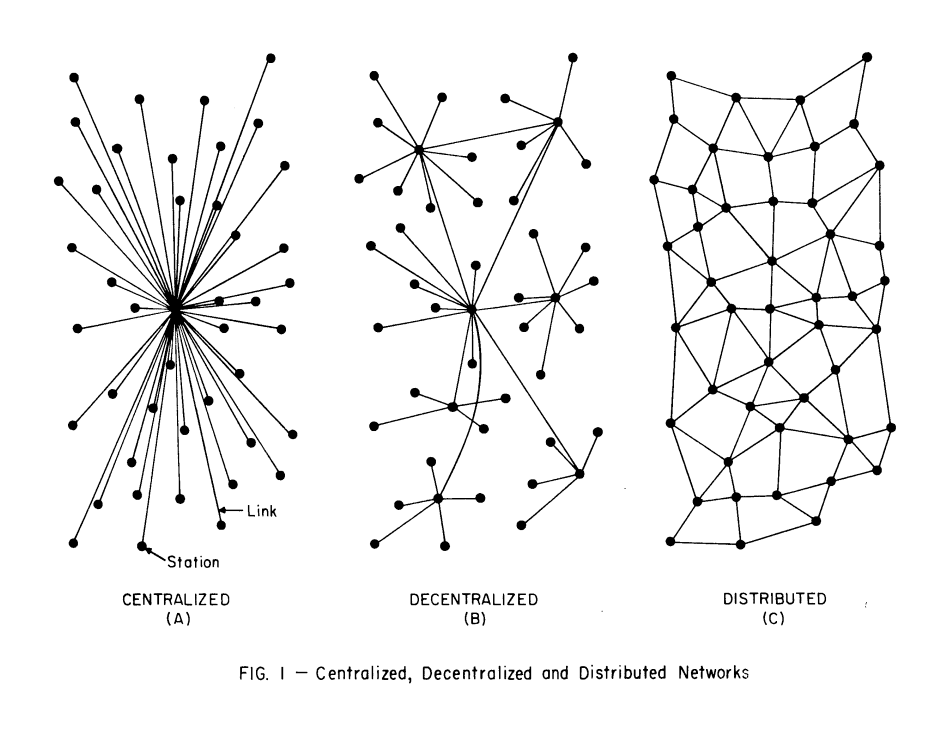
The full paragraph linked to the cited figure is worth citing in its
entirety:
The centralized network is obviously vulnerable as destruction of a
single central node destroys communication between the end station.
In practice, a mixture of star and mesh components is used to form
communication networks. For example, type (b) in Fig. 1 shows the
hierarchical structure of a set of stars connected in the form of a
larger star with an additional link forming a loop. Such a network is
sometimes called a "decentralized" network, because complete reliance
upon a single point is not always required.
In other words, in Baran's paper, where he is defining a
new and more robust vision for what he calls "distributed networks",
he is providing "decentralized" as a pre-existing term, not his own
definition, for a topology he is criticizing for
still being centralized! (Observe! If you read the paragraph
carefully Baran is saying that "decentralized" networks like this are
still "centralized"!)
Let's observe that again. Baran is effectively saying that a tiered,
hierarchical system with many nodes, being called "decentralized"
(because that is a term that already existed for these kinds of
networks), was in fact centralized. So the very definition selected by
Mark Nottingham (and thus Bryan as well) was being criticized for being
too centralized by the original cited author!
Baran had to introduce a new term because the term "decentralized" was
already being used. However, when we talk about "centralized" vs
"decentralized" as if they are polar ends of a spectrum, we are actually
talking about type (a) of "Figure 1" being "centralized" and type (c)
being the "ideal" version of "decentralized", with (b) sometimes showing
up as kind of a grey-area space. Notably, Mark Nottingham makes no such
distinction as Baran does between "decentralized" and "distributed", yet
uses the definition of "decentralized" that instead resembles tiered,
hierarchically centralized systems... not the version of
"decentralized" to which Mark Nottingham then goes at great length to
analyze.
That is why Baran's definition of "decentralized" is so weak.
This is critical history to understand!
In other words:
- Contemporary nomenclature: "Centralized" and "Decentralized" as polar
ends of a spectrum.
- Baran nomenclature: "Centralized and "decentralized" are both
centralized topologies, but the latter is hierarchical. "Distributed"
is the more robust and revolutionary view.
Do you see it? To use the latter's definition of decentralization to
describe the former is to use a definition of centralization. This is
not a good starting point.
Baran, notably, is bold about what he calls distributed systems, and
it is important to understand Baran's vision as being bold and
revolutionary for its time. I can't resist quoting one more paragraph
before we wrap up this section (remember! nothing like the internet had
yet been proposed or envisioned as something possible before!):
It would be treacherously easy for the casual reader to dismiss the
entire concept as impractically complicated -- especially if he is
unfamiliar with the ease with which logical transformations can be
performed in a time-shared digital apparatus. The temptation to throw
up one's hands and decide that it is all "too complicated," or to say,
"It will require a mountain of equipment which we all know is
unreliable," should be deferred until the fine print has been read.
May that we all be so bold as Baran in envisioning the system we could
have!
Why is this terminology discussion so important?
Here I have, at even greater length than my previous post or even
Bryan's own response to mine, gone into great length about terminology.
But this is important. As I have stated, there are great risks in
moving the goalposts. It is hard for those who do not work on
networked systems day in and day out to make sense of any of this.
"Decentralization washing" is a real problem. I don't find it
acceptable.
Bryan "chose his fighter" with Mark Nottingham's RFC, and the choice of
fighter informs much that follows. Mark Nottingham himself is
advocating that a push too hard on decentralization is something
standards people should not be doing, and if they do, should be scoping.
Some amount of centralization, according to Mark, is useful, good, and
inevitable, and we should scope down the amount of decentralization vs
centralization topics that come up in standards groups to something
actionable. Mark's reasons are well studied, and while Mark's history
often comes from a background in representing standards on behalf of
larger corporations, I believe he would like to see decentralization
where possible, but is "pragmatic" about it.
(This is also somewhat of a personal issue for me; my participation in
standards has been generally as more "outside the system" of corporate
standards work than the average standards person, and there's a real
push and pull between how much standards orgs tend to be dominated by
corporate influence. I'm not against corporate participation, I think
it's important but... I highly recommend reading Manu Sporny's
Rebalancing How the Web is Built
which describes the governance challenges, particularly leading to
corporate capture, which tend to happen within standards orgs. One of
the only reasons I believe ActivityPub was able to be as "true to its
goals" as it was is partly that the big players refused to
participate at the time of standardization, which at the time was an
existential threat to the continuation of the group, but in retrospect
ended up being a blessing for the spec. It both is and is not an aside,
but getting further into that is a long story, and this is already a
long article.)
Mark's choice to use the definition of "decentralization" from Baran is
however dangerous to read without understanding the surrounding
context. The way Baran used the term was as a
criticism of hierarchical centralization, and was introducing a
new term as an alternative. This is why Baran's definition of
"decentralization" appears so weak: Baran was not advocating for the
ideas he was scoping under that (pre-existing in the context he was
arguing within) term.
I personally don't believe we need to support the three-word
"centralization", "decentralization", and "distributed" phrases which
Baran used, it's fine for me to have a spectrum between "centralized"
and "decentralized". But we should not conflate a situation where
"decentralization" means "tiered centralization" with the contemporary
usage of "resisting centralization".
However, all this is to say that I think Nottingham's view on
how much we should be bothering to be concerned with centralization vs
decentralization aligns well with ATProto and Bluesky's own
interpretations. "Credible exit", I still assert, is a separate view, a
particular mechanism to avoid some of the challenges of centralization
going bad, and indeed in Nottingham's own RFC, it is only one path of
several examined, but the one Nottingham appears most aligned with as
practically possible.
Regardless, I'd still say then: if Bluesky does not meet my definition
of "decentralized", the solution is not to move the goalposts. I think
I've made it clear enough, with a thorough enough reading of the
literature, of why to accept the proposed definition within Bryan's post
would be to move the goalposts. I don't think that's intentional, or
malicious, but it is the result, and I'm not satisfied with that result.
That's enough said on the topics of terminology. Let's move on.
What happens when ATProto scales down?
A specific form of scale-down which is an important design goal is
that folks building new applications (new Lexicons) can "start
small", with server needs proportional to the size of their
sub-network. We will continue to prioritize functionality that
ensures independent apps can scale down. The
"Statusphere" atproto
tutorial demonstrates this today, with a full-network AppView
fitting on tiny server instances.
I won't spend too long on this other than to say: a large portion of the
arguments for why to choose ATProto's architecture specifically was to
"not miss replies/messages", and as said in my previous article, that
requires a god's-eye view of the system. Here it's argued that ATProto
can scale down, and yes it can, but is that the architecture you
want?
Given that message passing systems, by having directed messaging, is
able to scale down quite beautifully but still interoperate
as much as one would like with a larger system, what is the value of
using an architecture which scales down with much more difficulty and
which is oblivious of external interactions without knowing all of them?
I made a claim here: ATProto doesn't scale down well. That's mainly
because to me, scaling down still means being participatory with as much
as you'd like of a wider system while still having small resources.
What I would like to analyze in greater detail is why
ATProto doesn't scale wide. To me, these two arguments are
inter-related. Let's analyze them.
Defending my claim: decentralized ATProto has quadratic scaling costs
In my previous article, I said the following:
If this sounds infeasible to do in our metaphorical domestic
environment, that's because it is. A world of full self-hosting is
not possible with Bluesky. In fact, it is worse than the storage
requirements, because the message delivery requirements become
quadratic at the scale of full decentralization: to send a message to
one user is to send a message to all. Rather than writing one letter,
a copy of that letter must be made and delivered to every person on
earth.
However, clearly not everyone agreed with me:
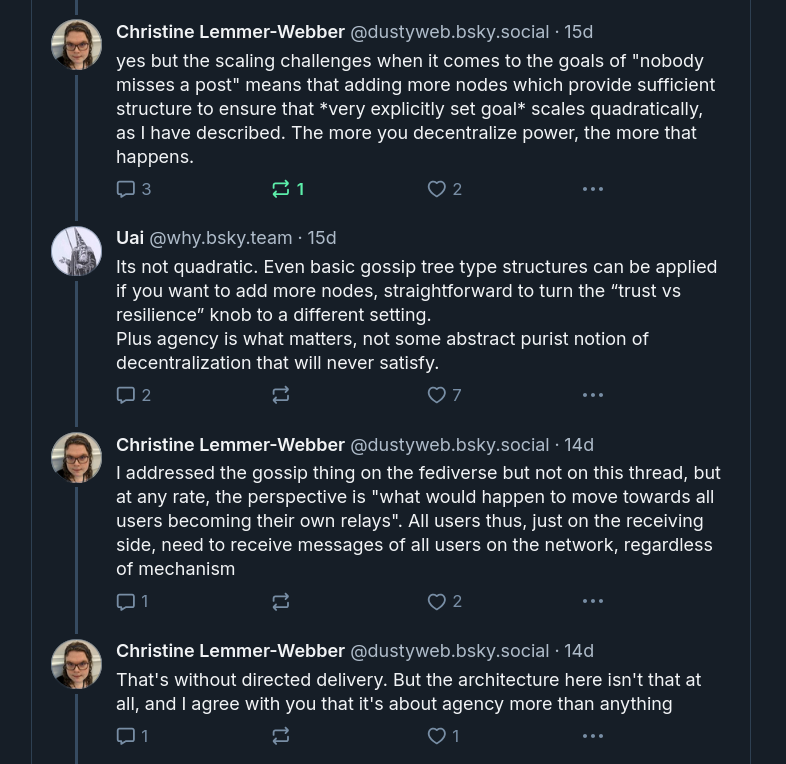
"Agency" really is important to me, probably
the most important thing,
but we will leave this aside for the moment and focus on a different
phrase: "participatory infrastructure".
Was I right or wrong that as nodes are added to ATProto that the scaling
costs are quadratic? After I read this exchange, I really doubted
myself for a bit. I don't have a formal background in Computer Science;
I learned software engineering through community educational materials
and honed my knowledge through the
"school of hard thunks".
So I spent a morning on the Spritely engineering call distracting my
engineering team by walking through the problem. It's easy to get lost
in the details of thinking about the roles of the communicating
components, so Spritely's CTO, David Thompson,
decided to throw my explainer aside and work through the problem
independently. Dave came to the same conclusion I did. I also called
up one of my oldschool MIT AI Lab type buddies and asked hey, what do
you think? I think this is a quadratic scaling problem am I wrong? He
said (from vague memory of course) "I think it's pretty clear
immediately that it's quadratic. This is basic engineering
considerations, the first thing you do when you start designing a
system." Well that's a relief that I wasn't confused. But if it seemed
obvious to me, why wasn't it obvious to everyone else? "It seemed
pretty clear the way you described it to me. So why don't you just
repeat that?"
So okay, that's what I'll do.
Let's start with the following points before we begin our analysis:
- We will assume that, since ATProto has partly positioned itself as
having one of its key values be "no compromises on centralized use
cases" including "no missed messages or replies", that at minimum
ATProto cannot do worse than ActivityPub, in its current deployment,
does today. Replies and messages addressed to specific users (whether
or not addressing is on the protocol layer or extrapolated on top of
it) must, at least, be seen by the their intentional recipients.
- We will start with the assumption that the most centralized
infrastructure is one in which there is only one provider controlling
the storage and distribution of all messages: the least amount of
user participation in the operation of the network.
- We will, on the flip side, consider decentralization to be the
inverse, with the most amount of user participation in the operation
of the network. In other words, "every user fully self hosts".
- We will also take the lessons of my previous post at face value; just
as blogging is decentralized but Google (and Google Reader) are not,
it is not enough to have just PDS'es in Bluesky be self-hosted. When
we say self-hosted, we really mean self-hosted: users are
participating in the distribution of their content.
- We will consider this a gradient. We can analyze the system from the
greatest extreme of centralization which can "scale towards" the
greatest degree of decentralization.
- We will analyze both in terms of the load of a single participant on
the network but also in terms of the amount of network traffic as a
whole.
With that in place, it's time to analyze the "message passing"
architecture vs the "shared heap" architecture in terms of how they
perform when scaling.
Here is my assertion in terms of the network costs of scaling towards
decentralization, before I back it up (I will give the computer
science'y terms then explain in plain language after):
- There is an inherent linear cost to users participating on the
network, insofar as for
n users, there will always be an O(n)
cost of operation. "Message passing" systems such as ActivityPub, at full
decentralization:
- Operate at
O(1) from a single user's perspective - Operate at
O(n) from a whole-network perspective (and this is, by
definition, the best you can do)
"Public no-missed-messages shared-heap" systems such as ATProto, at
full decentralization:
In other words, as we make our systems more decentralized, message
passing systems handle things fairly fine. Individual nodes can
participate on the network no matter how big the network gets. Zooming
out, as more users are added to the decentralized network, the message
load is roughly the normal amount of adding more users to the network.
However, as we make things more decentralized for the public shared
heap model, everything explodes, both on the individual node level, but
especially when we zoom out to how many messages need to be sent.
And there is no solution to this without adding directed message
passing. Another way to say this is: to fix a system like ATProto to
allow for self-hosting, you have to ultimately fundamentally change it
to be a lot more like a system like ActivityPub.
This can easy to get lost about; the example above of stating that
"gossip" can improve things indicates that talking about message
sending is confusing the matter. It will be easier to understand by
thinking about message receiving.
To start with a very small example by which we can clearly observe the
explosion, let's set up a highly simplified scenario. First let me give
the parameters, then I will tell a story. (You can skip the following
paragraph to jump to the story if that's more your thing.)
That n number we mentioned previously will now stand for the
number-of-users on the network. We will also introduce m which will
be number-of-machines, which represents the number nodes on the
network. Decentralizing the system involves n moving towards m, so
at full decentralization, n and m would be the same; at intermediate
levels of decentralization it may be less, but n converges towards
m as we decentralize. Each user is individually somewhat chatty, and
sends a number of daily-messages-per-user, but we can average these
out across all users, so this is just a constant which for our cases we
can simplify to 1 for a modeled scenario (though it can scale up and
down, it does not affect the rate of growth). Likewise, each message
individually sent by a user has a
number-of-intended-recipients-per-message, which we can average by the
amount of people who were individually intended to receive such message,
such as directed messages or subscribers in a publish-subscribe system;
however this too can be averaged, so we can also simplify this to 1
(so this also does not affect the rate of growth).
Lost? No worries. Let's tell a story.
In the beginning of our network, we have 26 users, which conveniently
for us map to each letter of the English alphabet: [Alice, Bob, Carol, ... Zack]. Each user sends one message per day, which is intended to
have one recipient. (This may sound unrealistic, but this is fine to
do to model our scenario.) To simplify things, we'll have each user
send a message in a ring: Alice sends a message to Bob, Bob sends
a message to Carol, and so on, all the way up to Zack, who simply we
wrap around and have message Alice. This could be because these
messages have specific intended recipients or it could be because Bob
is the sole "follower" of Alice's posts, Carol is the sole
"follower" of Bob's, etc.
Let's look at what happens in a single day under both systems.
Under message passing, Alice sends her message to Bob. Only Bob
need receive the message. So on and so forth.
- From an individual self-hosted server, only one message is
passed per day: 1.
- From the fully decentralized network, the total number of messages
passed, zooming out, is the number of participants in the network: 26.
Under the public-gods-eye-view-shared-heap model, each user must know
of all messages to know what may be relevant. Each user must
receive all messages.
From an individual self-hosted server, 26 messages must be received.
Zooming out, the number of messages which must be transmitted in the
day is 26 * 26: 676, since each user receives each message.
Okay, so what does that mean? How bad is this? With 26 users, this
doesn't sound like so much. Now let's add 5 users.
But we aren't actually running networks of 26 users. We are running
networks of millions of users. What would happen if we had a million
self-hosted users and five new users were added to the network? Zooming
out, once again, the message passing system simply has five new messages
sent. Under the public shared heap model, it is 10,000,025 new messages
sent! For adding five new self-hosted users! (And that's even just
with our simplified model of only sending one message per day per
user!)
Maybe this sounds silly, if you're a Bluesky enthusiast. I could hear
you saying: well Christine, we really aren't planning on everyone self
hosting. Yes, but how many nodes can participate in the system at all?
The fediverse currently hosts around 27,000 servers (many more users,
but let's focus on servers). Adding just 5 more servers would be a blip
in terms of the affect on the network. Adding 5 more servers to an
ATProto ecosystem with that many fully participating nodes would be an
exhausting number of additional messages sent on the network. ATProto
does not scale wide: it's a liability to add more fully participating
nodes onto the network. Meaningfully self-hosting ATProto is a risk
to the ATProto network, there is active reason to disincentivize it for
those already participating. But it's not just that. Spreading things
around so that more full Bluesky-like nodes are present is something
server operators will have to come to discourage if they don't want
their already existing high hosting costs to not skyrocket.
Now, what about that mention of "well gossip could help"? This is why I
said it is important to think of messages as they are received as
opposed to how they are sent. The scenario I gave above was
a more ideal scenario than gossip. In a gossip protocol, a node often
receives messages more than once. The scenario I gave was more
generous: messages are only received once. You can't know information
unless it's told to you (well, unless you can infer it, but that's not
relevant for this case). It's best to think about receiving.
Architecture matters. There is a reason message passing exists. I
don't believe in the distinction between "it's a technical problem" or
"it's a social problem" most of the time when designing systems, because
it's usually both: the kinds of social power dynamics we can have are
informed by the power dynamics of our tech and vice versa. Who can
participate here? I agree with the agency concern, I am always deeply
concerned with agency, but here agency depends on providers. How big
do they have to be? How many of them can there be?
A lot of hope in Bluesky and ATProto is in terms of the dreams of what
seems possible. Well, for decentralization of Bluesky and ATProto to
even be possible, it must change its architecture fundamentally.
ATProto doesn't need to switch to ActivityPub, but in order to become a
real decentralized protocol, it has to become a lot more like it.
Reframing portable identity
Bryan has some nice responses to the did:plc stuff in his article, I
won't go over it again in depth here. I'll just say it was nice to see.
I actually think that despite all the concerns I laid out about the
centralization of did:plc, it's not something I'm all too worried
about in terms of the governance of the ledger of updates. It seems
like the right things are being done so that did:plc can be audited by
multiple parties in terms of working towards a certificate transparency
log, etc. That's good to hear.
My bigger concern is that if Bluesky shuts down tomorrow or is bought by
a larger player, in practice if Bluesky refuses to allow for a path to
rotating keys to move away, it'll be hard to do anything about that.
Still, Bluesky is doing more work in the decentralized identity space
than most at this point. I want to give them some credit there, and end
this little subsection on that positive note.
Bluesky's expectations of public content vs community expectations
ATProto's main design is built upon replicating and indexing the
firehose. That is its fundamental design choice and method of
operation.
I won't go into this too far here other than to say, I'm not sure this
is in alignment with what many of its users want. And we're seeing
this, increasingly, as users are being upset about finding out that
other providers have replicated and indexed their data. This is
happening in a variety of ways, from LLM training concerns, to
moderation concerns, etc.
I won't say too much more on that. I think it's just... this all just
gives me the feeling that the "speech vs reach" approach, and the idea
of a global public firehose, a "global town square" type approach... it
all feels very web 2.0, very "Millennial social media"... for Millenials,
by Millenials, trying to capture the idea that society would be better
if we all got everyone to talk to each other at once.
I think Bluesky is doing about as good a job as a group of people can
do with the design they have and are trying to preserve. But I don't
think the global context-collapse firehose works, and I'm not sure it's
what users want it either, and if they do, they really seem to want both
strong central control to meet their needs but also to not have strong
central control be a thing that exists when it doesn't.
And who can blame users for that? An alternative can not usually be
envisioned unless an alternative is presented.
So, what's the alternative?
On the values and design goals of projects and protocols
One thing I appreciated was where Bryan laid out Bluesky's values and
design goals:
Over the summer, I wrote a summary of Bluesky's progress on atproto on
my personal blog:
"Progress on atproto Values and Value Proposition".
Christine identified "Credible Exit" as one of these key
properties. Some of the other high-level goals mentioned there were:
- Own Your Identity and Data
- Algorithmic Choice
- Composable Multi-Party Moderation
- Foundation for New Apps
Any of these could be analyzed individually; I have my own
self-assessment of our progress in the linked article.
I think this is great for Bryan to lay out. They're a nice set of
goals. (I don't love the term "own your data" for various "intellectual
property" term-confusion adjacent reasons, but that's an aside; the
intended meaning is good.) Overall I think this is a pretty
reasonably set of goals and you can see why they would inform the design
of Bluesky significantly. You don't see many projects lay out their
values like this, and it would be good to see done more often.
On that note...
One thing I'd be curious to see is an equivalent set of design goals
for ActivityPub (or for Spritely's work,
for that matter). This might exist somewhere obvious and I just
haven't seen it. It might all differ for the distinct original
projects and individuals which participated in the standards process.
This was a nice ask to make. Let me address them separately.
ActivityPub's values and design goals
In a way, it's a bit harder for me to talk about the values and design
goals of ActivityPub. It happened in a larger standards group and
involved a lot of passing of hands. I think if I were to be robust
about it, I would also ask Evan Prodromou, Erin Shepherd, and Amy Guy to
weigh in, and maybe they should; I think it would be nice to hear. But
since I work with Jessica Tallon (and I'm kind of tired of writing this
and want to just get it out there) we had a brief talk this morning and
I'll just discuss what we talked about.
The SocialWG charter
is informative, first of all. It says the following:
The Social Web Working Group will create Recommendation Track
deliverables that standardize a common JSON-based syntax for social
data, a client-side API, and a Web protocol for federating social
information such as status updates. This should allow Web application
developers to embed and facilitate access to social communication on
the Web. The client-side API produced by this Working Group should be
capable of being deployed in a mobile environment and based on HTML5
and the Open Web Platform. For definitions of terms such as "social"
and "activity", please see the W3C Social XG report A Standards-based,
Open and Privacy-aware Social Web.
There are a number of use cases that the work of this Working Group
will enable, including but not limited to:
- User control of personal data: Some users would like to have
autonomous control over their own social data, and share their data
selectively across various systems. For an example (based on the
IndieWeb initiative), a user could host their own blog and use
federated status updates to both push and pull their social
information across a number of different social networking sites.
- Cross-Organization Ad-hoc Federation: If two organizations wish
to co-operate jointly on a venture, they currently face the problem
of securely interoperating two vastly different systems with
different kinds of access control and messaging systems. An
interoperable system that is based on the federation of
decentralized status updates and private groups can help two
organizations communicate in a decentralized manner.
- Embedded Experiences: When a user is involved in a social
process, often a particular action in a status update may need to
cause the triggering of an application. For example, a travel
request may need to redirect a user to the company's travel
agent. Rather than re-direct the user, this interaction could be
securely embedded within page itself.
- Enterprise Social Business: In any enterprise, different
systems need to communicate with each other about the status of
various well-defined business processes without having crucial
information lost in e-mail. A system built on the federation of
decentralized status updates with semantics can help replace email
within an enterprise for crucial business processes.
I think the "user control of personal data" is kind of like "owning your
own data" but with terminology I am more comfortable with personally.
Cooperation, even if organization-focused, is there, and embedding is I
guess also present. The "enterprise" use case... well, I can't say that
ever ended up being important to me, but "business-to-business" use
cases is partly how the Social Web Working Group was able to describe
that it would have enough W3C member organization support to be able to
run as a group (which the corporate members quickly dropped out, leaving
a pile of independent spec authors... in most ways for the best for the
specs, but it seemed like an existential crisis at the time).
But those don't really speak as values to me. When Jessica and I spoke,
we identified, from our memories (and without looking at the above):
- The need to provide a federation API and client-to-server api for
federated social networks
- Relatively easy to implement
- Feasible to self-host without relying on big players
- Social network domain agnosticism: entirely different kinds of
applications should be able to usefully talk to and collaborate with
each other with the same protocol
- Flexibility and extensibility (which fell out of json-ld for
ActivityPub, though it could have been accomplished other ways)
- A unified design for client-to-server and server-to-server. This was
important for ActivityPub at least. Amy Guy ultimately did the
important work of separating the two enough where you could just
implement one or the other.
- An implementation guide which told a story, included in the spec.
(Well, maybe I was the only one who really was opinionated about
that, but I still do think it was one of the things that lead AP to
be successful.)
In some ways though, that still doesn't speak enough of values to me,
though. I added this late in the spec, and I kind of did it without
consulting anyone until after the fact, sneaking it into a commit where
I was adding acknowledgments. It felt important, and ultimately it
turned out that everyone else in the group liked it a lot. Here it is,
the final line of the ActivityPub spec:
This document is dedicated to all citizens of planet Earth.
You deserve freedom of communication; we hope we have contributed in
some part, however small, towards that goal and right.
Spritely's values and design goals
Spritely is the decentralized networking
research organization I'm the head of. We're trying to build the next
generation of internet infrastructure, and I think we're doing
incredibly cool things.
It's easier for me to talk about the values of Spritely than
ActivityPub, having founded the project technically from the beginning
and co-founded it organizationally. Here is the original mission
statement which Karen Sandler and I put together:
The purpose of The Spritely Institute is to advance networked user
freedom. People deserve the right to communicate and have communication
systems which respect their agency and autonomy. Communities deserve
the right to organize, govern, and protect and enrich their members.
All of these are natural outgrowths of applying the principles of
fundamental human rights to networked systems.
Achieving these goals requires dedicated effort. The Spritely
Foundation stewards the standardization and base implementation for
decentralized networked communities, promotes user freedom and agency of
participants on the network, develops the relevant technologies as free,
libre, and open source software, and facilitates the framing and
narrative of network freedom.
But still, though we have a mission statement, we haven't written out a
bullet point list like this before and so I tried to gather Spritely
staff input on this:
- Secure collaboration: Spritely is trying to enable safe
cooperation between individuals and communities in an unsafe world.
We are working on tools to make this possible.
- Networks of consent: The cooperation mechanism we use is
capability security, which allows for consent-granted mechanisms
which are intentional, granted, contextual, accountable, and
revocable. Rather than positioning trust as all-or-nothing or
advocating for "zero trust" environments, we consider trust as
something fundamental to cooperation, but it's also something that is
built. We want individuals and communities to be able to build
trust to collaborate cooperatively together.
- Healthy communities: We must build tech that allows communities
to self-govern according to their needs, which vary widely from
community to community. We may not know all of these needs or
mechanisms required for all communities in advance, but we should
have the building blocks so communities can easily put them in place.
- User empowerment and fostering agency: We believe in users having
the freedom to communicate, but also to be able to live healthy lives
protected from dangerous or bad interactions. We want users to be
able to live the lives they want to live, as agents in the system, to
the degree that it does not harm the agency of other users in the
system. Maximizing agency and minimizing subjection, not just for
you and me, but for everyone, is thus is a foundation.
- Contextual communication: There is no "global town square", and
we are deeply concerned about
context collapse.
Communication and collaboration should happen from contextual flows.
- Decentralized is the default: We are building technology
foundations on top of which then the rest of our user-facing
technology is built. These foundations change the game: instead of
peer-to-peer, decentralized, secure tech being the realm of experts,
it's the default output of software built on top of our tech.
- Participatory, gatekeeper-free technology: Everyone should be
able to participate in the tech, without gatekeepers. This means we
have a high bar for our tech being possible for individuals to
meaningfully run and for a wide variety of participants to be able to
cooperate on the network at once.
- We should not pretend we can prevent what we cannot: Much harm
is caused by giving people the impression that we provide features
and guarantees that we cannot provide. We should be clear about the
limitations of our architecture, because if we don't, users may
believe they are operating with safety mechanisms which they do not
have, and may thus be hurt in ways they do not expect.
- Contribute to the commons: We are a research institution, and
everything we build is free and open source software, user-freedom
empowering tech and documentation. This also informs our choice to
run the Spritely Institute, organizationally, as a nonprofit building
technology for the public good.
- Fun is a revolutionary act: The reason technology tends to
succeed is that people enjoy using it and get excited about it.
We care deeply about human rights and activism. This is not in
opposition to building tech and a community environment that fosters
a sense of fun; planned carefully, fun is at the core of getting
people to understand and adopt any technology we make.
I will note that the second to last post, contributing to the commons,
makes running the Spritely Institute challenging in so far as the
commons, famously, benefits everyone but is difficult to fund. If the
above speaks to you, I will note that the Spritely Institute is, at the
time of writing,
running a supporter drive,
and we could really use your support. Thanks. 💜
This is not a post about Spritely, but I appreciate that Bryan invited
me talking about Spritely a bit here. And ultimately, this is
important, because I would next like to talk about the present and the
future, and the world that I think we can build.
Where to from here?
I am relieved that the previous piece was overall received well and was
not perceived as me "attacking" Bluesky. I hope that this piece can be
seen the same way. I may have been "harshly analytical" in my analysis
at times, but I have tried to not be mean. I care about the topics
discussed within this blogpost, and that's why I spent so much time on
them. I know Bryan feels the same way, and one thing we both agree on
is that we don't want to be caught in an eternal back-and-forth: we want
to build the future.
But building the future does mean clear communication about terminology.
I will (quasi)quote Jonathan Rees again, as I have previously when
talking about the nature of language
and defining terminology:
Language is a continuous reverse engineering effort between all
parties involved.
(Somewhat humorously, I seem to adjust the phrasing of this
quoting-from-memory just slightly every time I quote it.)
If we aren't careful and active in trying to understand each other,
words can easily lose their meaning. They can even lose their meaning
when shifting between defined contexts over time. The fact that Baran
defined the term "decentralization" as a particular kind of
centralization was because he was responding to a context in which that
term had already been defined (and thus introducing a new term
"distributed" to describe what we might call "decentralization"). The
fact that today we use "centralization" and "decentralization" as two
ends of a spectrum is also fine. I don't think Bryan quoting Mark
quoting Baran in this way and thus introducing this error was
intentional, but ultimately it helps explain exactly why the term
chosen produced a real risk of decentralization-washing.
I agree that Bluesky does use some decentralization techniques in
interesting and useful ways. These enable "credible exit", and are also
key to enabling some of the other values and design goals which Bryan
articulated Bluesky and ATProto as having. But to me, a system which
does not permit user participation in its infrastructure and which is
dependent on a few centralized gatekeepers is not itself decentralized.
So what of my analysis of the public-global-gods-eye-view-shared-heap
approach as growing quadratically in complexity as the system
decentralizes? I'm not trying to be rude in any way. I made a
statement about the behavior of the system algorithmically, and it felt
important that I not only assess whether or not that statement was true
because if it wasn't true then I would want to understand myself and
retract it. But there's interest and belief right now by many people
that ATProto can be "self hosted". It's important, at least, to
understand to the degree which that simply, under the current
architecture, it is not possible to do. Especially because right now a
lot of people are operating on this information out of belief in and
hope for the future. If my assertion about the quadratic explosion
problems of meaningfully decentralizing ATProto are false, and that it
is possible for self-hosting to become common in the system with the
properties that Bluesky has set out as being key features still being
possible to be preserved, then I will welcome and retract that
assertion.
However, I suspect that the reality is that I am not wrong, and instead
what we will see is a shift in expectations about what is possible for
Bluesky to be decentralized and in what capacity. Some people will be
upset to have a new realization about what is and isn't possible, some
people will simply update their expectations and say that having only a
few large players be able to provide a Bluesky-like experience is
actually good enough for them (and that what they're interested in
instead is API-consumer-and-redistributor features on top of Bluesky's
API), and the majority of the network will have the same level concern
they have always had: none.
The reality is that most of Bluesky's userbase doesn't know or care
about or understand the degree to which Bluesky is decentralized, except
for potentially as a reassurance that "the same thing can't happen here"
as happened on X-Twitter. "Decentralization" is not the escape hatch
people think it might be in Bluesky, but it's true that "credible exit"
may be. However, the credibility of that exit currently predicates on
another organization of the same cost and complexity of Bluesky standing
in if-or-when Bluesky ends up becoming unsatisfying to its users.
But the indifference towards Bluesky's "credible exit", indeed the
indifference towards very architecture on which Bluesky is built,
puts Bluesky at an immediate collision course of expectations.
ATProto's entire design is built on the foundational expectation of
replicating and indexing its content by anyone, but the discovery that
this is possible for purposes which users are not excited about has
begun to lead to an increased backlash by users, many of whom are
increasingly asking for solutions which are effectively centralized.
To me, this collision course is unsurprising, and I am empathetic
towards users insofar as that I think we are seeing that the global
public firehose worldview is perhaps not the right way to do things. I
laid out a different set of values that Spritely is pursuing, and I
think that a system that encompasses these values is a system which
better fits the needs of users. I think we need systems which empower
users and healthy communities, secure collaboration, and all the other
values we put out above. Those are the design goals, but Spritely is on
a longer roadmap in terms of deliverables than Bluesky is. And Bluesky
has a userbase now. So perhaps this observation sounds thoroughly
unhelpful. I don't know. But I will say I am not surprised to see that
the vibes on Bluesky shifted dramatically between three weeks ago when I
wrote the first article and today. In many ways, Bluesky is
speedrunning the history of Twitter. Investor pressure towards
centralization compounded with users who are upset to find their content
replicated and indexed by people they don't like will likely combine
into a strong push to restrict Bluesky's API, and I'm not sure myself
how this will play out for certain.
And all of that sounds fairly negative, so let me shift towards
something positive.
I still do truly believe that "credible exit" is a worthy goal.
Actually, I think that (perhaps with one mentioned wording change) all
of Bluesky's stated goals are actually quite good. I think Bluesky
should continue to pursue them. And I think Bluesky has a team that is
interested in doing so. There may be opportunities to share knowledge
and collaborate on solutions between Bluesky and other projects,
including those I work on. I know Bryan and I are both interested in
such. And I said in the previous article how much I respect Jay Graber,
and that's true. I also respect Bryan Newbold tremendously. One thing
is true for certain: Bryan is a believer in all of the ideals he
previously stated. I respect him for that. I would like to see those
ideals succeed as far as they possibly can. Perhaps there are even ways
to do so together. I will not waver in my goals and values, but I
am a strong believer in collaboration where it is fruitful.
And that is the conclusion to what I have to say on the matters of
Bluesky and decentralization. I will probably comment on the fediverse
and Bluesky itself, but I don't think I will write another blogpost like
these two mega-posts I have written. I am not personally interested in
going back-and-forth on this any longer. More than I am interested in
laying out concerns, by far, I am interested in building the future.
Thanks for listening.